MENU
PROCESS AND SUPPORT WORK
Something(20240101-)
For this photo print work (still image), I have decided to cut out human figures from my archive of surveillance footage and play around with different arrangement. At first I look out pedestrians with special poses, such as doing a cartwheel, then I decided to focus on the walking posture. Eventually I chose to include the first person crossing the road at 11:35am each day, which was the time when the Beatles did the photo shot in 1969. After different trials, I decided to arrange the figures in a horizontal sequence, taking reference with Muybridge's series of Human Locotion.


Having decided on the sequencing, I also tested with different printing materials and cutting. I tried laser and inkjet print on matte paper and acetate. I also considered printing on vinyl which was a common option for artwork of this kind, but I was afraid that it would fall flat and the install would be unforgiving. To achieve a floating effect of the print, I decided to print on a long stripe of matte paper.


Attracts Me Like a Record Player
During research I came across several modern applications of early cinema technique. One was Mat Collishaw's exhibition at Kew Gardens, where his work The Centrifugal Soul was on display. 3D-printed birds were animated as the central zoetrope span under a strobe light.
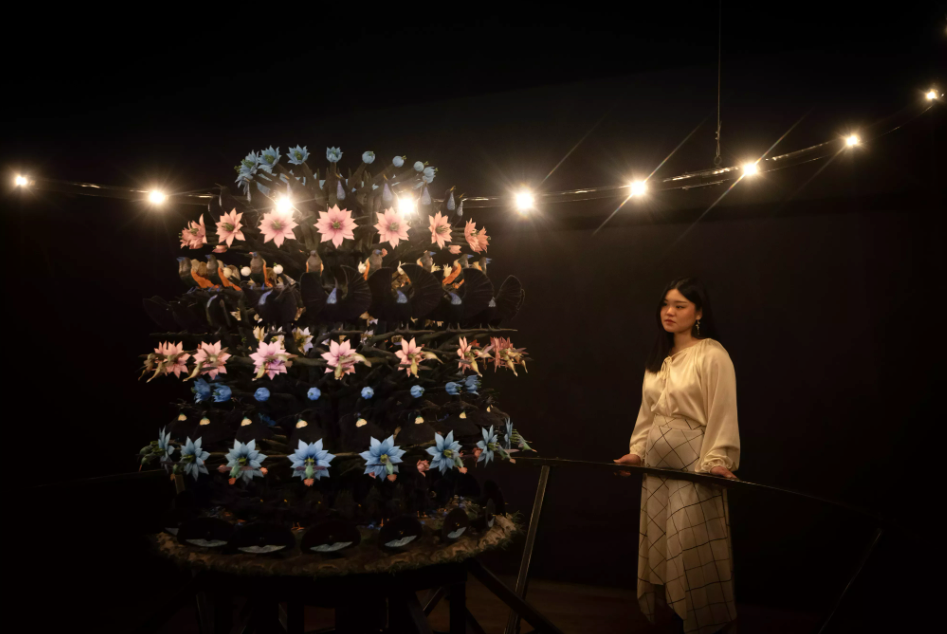
The Centrifugal Soul by Mat Colishaw © RBG Kew


Abbey Road Movies
Looking at the repeated actions from the Abbey Road Cam, I came up with the idea to present them as a never-ending walking sequence. As pedestrians captured on the surveillance footage appeared on different days with different lighting and road condition, I would need to extract the human figures from the scene in order to make a seamless sequence. I explore different ways to do it and came across rotoscope, an animation technique that involves tracing over live-action footage frame by frame to create realistic action. I try to use motion tracking function of video editing softwares to extract the figures. Due to the footage's low quality, the resulting figures look like shadows or ghosts. This is quite a match to the themes that I am exploring, because they are people walking in the past, who are summoning the spirits in a walking sequence even longer time ago. It also echoes the cinema's nature to fossilised the death. The figures' graininess also matches the texture of CRT TV screens, which eventually become part of the video sculpture piece.
When considering the sound for the moving image, I initially thought of playing the live feed's real-time audio to accompany the visuals. I later turned to the Beatles' Abbey Road album to see if any songs could complement the piece. I found out that the lyrics of the songs Something and Because could be a match to the visual. The opening line of Something, "Something in the way she moves," and the first line of Because, "Because the world is round, it turns me on," are both fitting. While Something offers a clear connection to the visuals, I was drawn to the melody of Because for its potential to add an uncanny layer to the work.
I created one version using a rendition of Because by a string quartet. Some who have seen it found it quite poetic, but others described the music as "decorative". Given the repetitive nature of the moving image, I decided to mirror this repetition by extracting and looping the first line of the song throughout the piece’s duration. My intention was to encourage viewers to step back from the work and reflect on what exactly the are seeing.
In hindsight, I still question whether I should use the string version of the song. Coupled with the visuals, the harmony between the music and the repeating walking sequence reflects a certain beauty within the mundane. I can still recall how some viewers of the earlier version were moved by it. This leaves me wondering if the piece should aim to resonate with the viewer’s soul, or challenge them by creating a sense of alienation.
The lyrics of Something eventually inspired three of the work titles in the series. As the works are created by reorganising found internet footage, by the same token the titles are appropriated from existing materials. Coincidentally, the opening lyric of Something was itself borrowed from the title of another song, demonstrating the Beatles’ own use of appropriation. One of the work titles, Attracts Me Like a Record Player, is a playful reinterpretation of the song's original line, "attracts me like no other." John Lennon once used the temporary filler "attracts me like a cauliflower" before the final lyrics were written. This inspired me to alter the last few words that connects back to the work's component.

Earlier version of Abbey Road Movies
(click the button on the bottom right to turn on sound)


The other occasion was a Youtube video introducing the trend of having animated patterns on vinyl records. I was drawn by the idea that one could only see the moving image when the record was turning. Using a turntable as material fits my theme well, as my work is originated from the Beatles' album cover. I selected various subjects from the Abbey Road Cam, and experimented with different arrangements of the frames, eventually chose to feature a group of four pedestrians re-enacting the Beatles' walking sequence, and another pedestrian doing a cartwheel. To make it more interesting and amplify the uncanniness, frames are arranged in the way that people in different circles walk to opposite directions. It also symbolises a never-ending urge to repeat the action, as well as the hunger for moving images as spectacles. Instead of a strobe light, I deliberately choose to animate the frames with a phone camera, the ubiquitous tool for capturing images. It is also to connect the old technology (zoopraxiscopes, record players) and the new (mobile phones). Viewers are invited to animate the sequence with their own phones.
The plinth supporting the record player becomes an integral part to reflect how the old and new technologies converge in this piece. Therefore, instead of going for the common white plinth, I decided to make a metal plinth at the metal workshop. Its wooden top panel matches the aesthetics of the record player, while its metal legs echo the set-up of the mobile phone on tripod.
Recalling the exhibition where I showed Relativity, the work did attract attention, but mostly not in the way that I intended. Visitors did all sort of things in front of the camcorder, from making funny faces to dancing, reminding me of human's instinct of interacting with our own images. This time I comfortably embraced any forms of interaction, as my work created spectacles out of the visitors' own image. Same as last time, the camcorder remained a tool for surveillance as it recorded every act they did, echoing my intent to explore the relationship between voyeurism, exhibitionism and surveillance.
You Stick Around Now It May Show
When trying out different arrangements for my unit 2 work Relativity, at one point I made the camcorder pointing at the TV screen, resulting a feedback loop that creates captivating visuals. I included it in my series of work for unit 3, as the set-up can effectively turn the visitors' walking posture into spectacles. Originally I thought of placing the work at the little stairs near the library, but due to safety concerns I decided to move it to the wall leading to my video installation piece. This was actually a good move. During the summer show, a lot of visitors walked past the work without noticing it at first, as they navigated along the passage to see my video installation. It was only when they noticed something moving and gave it a second glance, that they realised it was their walking posture, a process reflected in the work's title. The arrangement also made a parallel between the two pieces. What the visitors saw in the moving image piece were walking sequences captured by the (old) live feed of a surveillance camera, and with the feedback loop they could see their own walking posture being turned into spectacles in real time.