MENU
Life's but a Walking Shadow
CRITICAL REFLECTION
Over the past year, I have been contemplating the moving image as a form of spectacle. From the early days of the camera obscura to Lumière brothers’ pioneering films, moving images have captured and emulated daily life routines, presenting them as spectacles for an audience. In the age where Andy Warhol’s “fifteen minutes of fame” has been diluted to fifteen seconds, I find myself being drawn to the daily dose of walking shadows, casted by pilgrims re-enacting the Beatles’ iconic pose as they cross Abbey Road 55 years ago. The zebra crossing is captured and immortalised by a surveillance camera, broadcasting live and round the clock, on the streaming website earthcam.com. I am captivated by the live feed of perfect mimicking and the outtakes, as well as other impromptu performances, each shaped by a shared cultural memory. Production and consumption of these images epitomise how viewers are drawn to surveillance content as spectacle, encapsulated within the form of the moving image.
Captivated by the idea of Oulipo, which is a way of art-making by imposing multiple restrictions to it, I started collecting screen recordings from the Abbey Road Cam each day at 11:35am, the same time when the Beatles originally made the crossing and being photographed on 8 August 1969. Through this ritual I have built a database of individuals crossing and posing at the site, captured through a digital lens that makes each crossing both fleeting and eternal.

An Attempt at Exhausting a Place in Paris by Georges Perec (1974)
In my previous reflections on cinema history, Eadweard Muybridge has featured prominently as a figure who connects still and moving images, driven by his obsession with capturing motion. In his book Road Movies: From Muybridge and Méliès to Lynch and Kiarostami, Devin Orgeron proposes that the desire of Muybridge’s action and the viewers’ longing for the subject converge around the turn of the century “attractiveness” of transportation, which is an attraction motivated by curiosity and fear (Orgeron, 2008).
Acknowledging the impact of locomotive advancement on contemporary spectators in the 1800s, Ian Christie also describes that the move from the carriage window to the screen was an easy transition and that “sixty years of railways had prepared people to be film spectators” (Christie, 1995). The cinema is invented to recreate these ways of seeing. Orgeron notes that some of the early cinema subjects simulate the mechanics of travel and created a spectatorial subject receptive to the narrative situation of “the journey”, and by the mere act of viewing, the spectator agrees to “participate in an elaborate fiction” which is “derived from the visual situation and vocabulary of travel” (Orgeron, 2008). He puts forward that motion itself is inherently narratival as it “simultaneously shows and tells a story”, or it “tells through showing” (Orgeron, 2008).
The power of motion as a narrative form, even at its most primitive level, is foundational to my work. The “cinematic event” in the walking posture is stripped down, reflecting the travel situation in its most primitive form. Yet the motion itself carries a narrative that captures and captivates viewers. The reference to the Beatles may add another narrative layer, enriching the spectacle with cultural resonance.
My collection of Abbey Road Cam footage, started from 1 January 2024

In the essay Time and Free Will, first published in 1889, French philosopher Henri Bergson articulates that motion is actually a mental synthesis, as the moving body only occupies part of space at a certain point of her movement. It is the conscious spectator that keeps successive positions in mind and pieces them together to create a continuous movement (Bergson, 2001). This conception, or “construction” of motion mirrors the mechanisms of cinema, where optical tricks are employed to create illusion of motion.
In my Unit 2 work, I explored how individual frames are linked together in the viewer’s mind to form a seamless and complete sequence. The cinematic mechanism is tied to its origin in Photography. The four-dimensional reality is frozen and conflated onto the two-dimensional surface of a photograph and remains static, to be unravelled only when the viewer reads the image and restore the sequence in their mind.
The Abbey Road phenomenon embodies the same mechanism. Still image of the Beatles’ on the album cover captures a single frame within a movement, which elicits the viewer’s imagination of the complete sequence. This imagined sequence is brought to life in the actual, physical space through re-enactment. As pedestrians walk on the zebra crossing, some freeze their actions to form a tableau vivant. While this effectively repeats the cycle and reinforces the sign, what they are doing is, in fact, re-enacting a still image of the walking sequence. Paradoxically, the moments before and after the frozen pose are real re-enactment of the original act: the simple yet symbolic motion of walking.
This phenomenon, along with my subsequent work, illustrates how the dynamism within a frame of movement—even in a “non-narrative” act like walking—carries narrative potentials that evoke emotional resonance, which may explain the viewer’s obsession with motion. Meanwhile, some pedestrians, clearly imitating the Beatles' pose, complete the sequence without giving a pause. Their walking sequence is familiar as an everyday routine, yet alienated by their exaggerated manner. The ordinary is made uncanny and transformed into spectacles. The visual language I employ in my moving image piece amplifies the uncanniness embedded within the mundane.
Louis Lumière's Workers Leaving The Lumière Factory in Lyon (1895)
Walking is featured as the main narrative drive in the first motion picture ever screened for a public audience
References:
Orgeron, D. (2008). Road movies : from Muybridge and Melies to Lynch and Kiarostami. Basingstoke: Palgrave Macmillan.
Christie, I. (1995). Last Machine. British Film Inst.
Bergson, H. (2001) Time and free will: An essay on the immediate data of consciousness. Mineola, N.Y: Dover Publications.
Ingraham, C. and Rowland, A. (2016). Performing Imperceptibility: Google Street View and the Tableau Vivant. Surveillance & Society, 14(2), pp.211–226. doi:https://doi.org/10.24908/ss.v14i2.6013.
Palais des beaux-arts de Bruxelles (2020). Hand Movie (Yvonne Rainer) - Danser Brut | Guided Tour | BOZAR. [online] YouTube. Available at: https://www.youtube.com/watch?v=qb7wloNEIkk [Accessed 6 Nov. 2024].
The Museum of Modern Art. (n.d.). Yvonne Rainer. Trio A. 1978 | MoMA. [online] Available at: https://www.moma.org/collection/works/119867.
Rainer, Y. (2021) ‘No Manifesto (1965, 2008)’, in Posthumanism in art and science: A reader. New York: Columbia University Press, p. 97.
Respini, E. (2018) in Art in the age of the internet: 1989 to Today. Boston, MA, New Haven, CT: The Institute of Contemporary Art/Boston ; Yale University Press.
Cornell, L. and Halter, E. (2015). Mass effect : art and the internet in the twenty-first century. Cambridge, Massachusetts: The Mit Press.
Lopes, D. (2010) A philosophy of computer art. London: Routledge.
Wood, M. (2012). Film : a very short introduction. Oxford ; New York: Oxford University Press.
Doane, M.A. (2002) The emergence of cinematic time: Modernity, contingency, the archive Mary Ann Doane. Cambridge, MA: Harvard University Press.
Mulvey, L. (2006). Death 24x a second stillness and the moving image. London Reaktion Books.

The Beatles' album cover as a tableau vivant

Still from Abbey Road Movies
(NO to) Spectacles in an Everyday Performance
The everyday act of walking transforms into both ritual and performance on the Abbey Road Cam. Dancer, choreographer and filmmaker Yvonne Rainer explored a similar duality, as she famously asserted that dance is hidden in the everyday, in daily rituals and routine acts (Palais des beaux-arts de Bruxelles, 2020). Rainer choregraphed Trio A and performed it for the camera in 1978, in which she performed a seamless flow of everyday movement. I seem to head in a completely opposite direction from Rainer. As a performance, what she tried to address in Trio A is the dual voyeuristic and exhibitionistic relation of dancer to audience (The Museum of Modern Art, n.d.). She was apparently critical about the spectacle, which is the first subject she targeted in her famous No Manifesto (NO to spectacle). Almost 60 years after the Manifesto was first published in 1965, spectacle is as ubiquitous as ever. The Abbey Road phenomenon exemplifies the entanglement of voyeurism, exhibitionism, and spectacle: the mundane act of walking becomes theatrical, pilgrims perform knowingly for the camera, and I observe their ritual on the webcam.
Revisiting No Manifesto in 2008, Rainer appended her original critique in the first verse: “Avoid if at all possible”. But if it is possible at all. The internet—the very medium through which you are reading this essay from—has made images the lingua franca of our distracted age. Motion as spectacle is omnipresent, more than ever, in our visually saturated world.
Falls of the Yosemite No. 23 by Eadweard Muybridge (1872-1873)

Muybridge's Animal Locomotion (1887)
.jpg)


Len Lye's Rainbow Dance (1936)

Peter Kubelka's Adebar (1957)
To Obscure is to Make You Look Again
The other day I visited Ken Artspace in South London, where artist Aliki Braine presented work from her summer residency. During the open studio, she introduced her new pieces, in which she cut and folded catalogue pages of Western European paintings and transformed them into woven albums. Illustrating how iconic paintings became mosaics in her work, she explained that "to obscure is to make you look again." Through her work, she invites viewers to reconsider the power structures underlying Western art history. In my work, anonymous performers from different days are choreographed together within a single scene to create a collective performance. It can only be possible to achieve by blurring and layering the old and new human postures. Transcending time, space and identify, the work invites viewers to engage with the narrative function of movement itself.
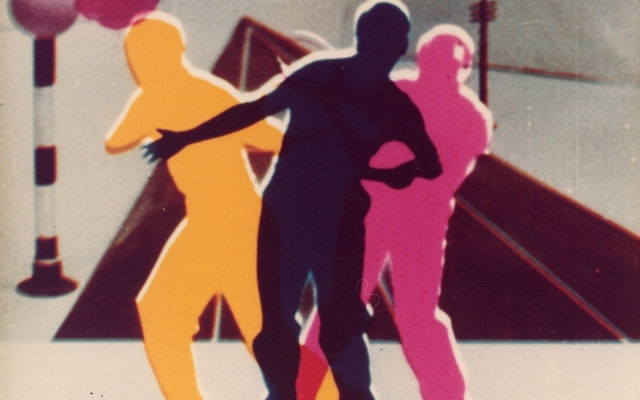
Visual language of my moving image piece finds its root in avant-garde cinema. Figuration and movements were illuminated with colour in Len Lye’s Rainbow Dance (1936). Commissioned by a dance-café to produce a commercial, Austrian filmmaker Peter Kubelka released the short film Adebar in 1957, which featured dancing silhouettes in a repetitive manner. Experimental techniques were employed to make human’s motions stand out in both films, emphasising movement over identity. In my own work, I used motion tracking to isolate pedestrians from surveillance footage. Benefiting from the webcam’s low quality, the resulting images feature figurines that resemble silhouettes or shadows. Here, as in Lye’s and Kubelka’s films, the emphasis on movement itself draws viewers in.
From my work, it is also fascinating to observe how human’s movement can be synchronised, as performers respond to similar cues at different instances: evading traffic, deciding to proceed or retreat, or engaging in spontaneous acts like cartwheels and ballet steps. These collective performances reveal a universal, performative instinct within human movement.
Still from Abbey Road Movies
“These Are Just Tricks, Not Art”
At the opening of our summer show, a visitor, who identified herself as a painter, pondered upon my work and asked “Where can I see fine art?” “This is fine art,” I responded. After I briefly introduced my work she hurried off, with the parting comment “These are just tricks, not art.” “Nice to see you!” I called to her receding walking shadow. Although her words stung, dismissing my work as mere “tricks,” her feedback prompted me to reflect on what constitutes art itself. A friend of mine once said my work often tickles the brain, but never gets to the soul. Could this be the distinction between a trick and a piece of art? How does an artwork’s medium inform its affect on the viewer?
To contextualise these questions, I need to first define my medium. My work may bear the label of post-internet art, a term coined by artist and writer Marisa Olson around 2006. Olson uses it to describe art made in the wake of spending time surfing the internet and “the yield of compulsive surfing and downloading, directly derived from materials on the Internet or the user’s activity there.” For Olson, the work is “less art 'on' the Internet than it is art 'after' the Internet (Respini et al., 2018).
How is (post-)internet art different from other art forms? To approach this question, I draw on Dominic McIver Lopes's framework in The Philosophy of Computer Art, where he attempts to make sense of the medium. Lopes suggests that every art work comprises some “structured entity that results from the artist's creativity and that we tune into when we appreciate the work.” He considers a work's display as a structure that results from the artist's creativity, and that we apprehend in order to grasp a work's meaning and aesthetic qualities (Lopes, 2010).
In traditional art forms, Lopes observes, artists have historically presented their work within the physical limits of galleries, where they engage (or attempt to change) the aesthetic expectations of gallery owners and art collectors. In contrast, digital image-makers can reach niche audiences with “diverse aesthetic expectations, using standards not accepted by the art world establishment, or with traditional art making tools” (Lopes, 2010). He recognises that computer art exploits the technology of computing in order to achieve interactivity. The philosophy of computer art is to “think about the work’s medium and how that medium affords experience and carries meaning” (Lopes, 2010).
A notable example is Super Mario Clouds by digital artist Cory Arcangel. Created by hacking Nintendo’s classic game, he removes all visual assets except for the white clouds and blue sky in the background. This work effectively shifts viewers' attention to the game’s banal elements and the gaming apparatus, undermining the game's actual purpose (Respini et al., 2018). Reflecting on this piece, he believes that the point of it is not necessarily the work itself, but rather to “show people that he did it and explaining how it was done” (Cornell and Halter, 2015). Arcangel demonstrates a way of art making that, rather than the work itself evokes sentiments, it is the method of creation that presents an phenomenon and asks questions. This approach is one I seek to achieve in my own work, aiming not only to present still and moving images, but to invite viewers to contemplate how it was made and the questions it raises.
Yvonne Rainer performing Trio A for the camera in 1978

No Manifesto (1965)
No Manifesto (2008)
Phantasmagoria and the Tricks of Reality
Reflecting on my brief conversation with the painter, it is intriguing that she chose the word “tricks” to describe the moving image piece in front of her. Since its inception, cinema relies on “tricks” to create the illusion of motion, deceiving the human eye. Celluloid motion pictures are, after all, a series of static and inanimate images that become animation when projected. As Michael Wood notes in his Very Short Introduction to Film, nothing moves in a film frame but only a succession of frames creates movement (Wood, 2012). The trick works so well that early cinemagoers failed to see stripes of darkness between the frames. Mary Ann Doane suggests that the “real time” on screen “is in fact haunted by absence, by the lost time represented by the division between frames” (Doane, 2002).
This illusion of motion, combined with the indexical link between the subjects caught by a lens and the image on film, cement the medium’s authority to represent reality. Wood further reflects that while photography stops life, film’s apparent recording of life’s movement “actually starts it again: a little resurrection every time” (Wood, 2012).
Cinema is an art form that hovers between life and death. In Death 24x A Second: Stillness and the Moving Image, Laura Mulvey traces cinema’s roots to forbidden practices of conjuring the devil and their modern rituals performed by magicians and illusionists. They developed “the arts of deception” to captivate human fascination with the unnatural, the impossible, and ultimately, the supernatural (Mulvey, 2006). As science advanced, technology intertwined with superstition and gave raise to various haunted stunts (Mulvey, 2006), culminating with the ghostly spectacle Phantasmagoria. Showmen, who mastered the arts of deception, began to remove the spell of superstition, shifting the spectacles’ awe from the supernatural to illusions themselves. With Phantasmagoria, the arts of deception was transforming to become that of reality. This haunting feast also inspired the title of my series, as I blend analogue and digital techniques to summon the spirits of a recurring walking sequence at Abbey Road.
Mulvey identifies that cinema is where the arts of reality and the arts of deception converge (Mulvey, 2006). Its fundamental trick to present reality as continuous motion can be achieved only through the illusion of movement and time. This simulation parallels our own perception: every continuous movement we see in the real world is illusory. Each time we open our eyes, they take “snapshots” of the visual scenes around us, and our brain puts them together to create a seamless experience of movement and distance. This perception, however, is constructed. Wood concludes that, in this way, whenever a movement is observed, the brain makes a movie. (Wood, 2012)

Cory Arcangle's Super Mario Clouds (2002)
To Surveil and to Strike a Pose
The Abbey Road Cam highlights the intersection of voyeurism and exhibitionism. Pedestrians, aware of the camera(s), pause to strike a pose, re-enacting and reproducing the consumable imagery of the Beatles’ original tableau vivant. Analysing tableaux vivant staged for Google Street View, Chris Ingraham and Allison Rowland point out that those performances reflect an “underlying motive and a desire to be recognized as a subject, a desire to say, like a kind of curbside bathroom graffiti, ‘I was here. Here I am.’” (Ingraham and Rowland, 2016). The same drive compels the Beatles’ pilgrims who strike a pose to register their place in pop culture. By engaging with an imagery that is instantly recognisable, they conjure up the spirits from a distant walking action, and mirror it in an effort to reproduce the “there, then” as a “here, now.” Much like Muybridge’s subjects, the Beatles’ pilgrims perform for their phone cameras, and knowingly or inadvertently for the surveillance webcam, feeding the hunger of their social media audience and a global, anonymous viewership. It is the exhibitionist desire that leads to a willingness to be under surveillance, in the form of (stopped) motion. If the essence of Muybridge’s series is man’s relationship with the machine, what the Abbey Road performers demonstrate is man’s relationship with a surveillance machine, which comprises the camera, the networked technology and its live streaming capability, and the internet’s voyeuristic and exhibitionist culture.
Surveillance was my core subject in Unit 1, and since then, my work has expanded into the realm of spectacle. Returning to the Abbey Road Cam for my final piece, I realised that my approach challenges the typical function of a surveillance camera. Instead of helping in identifying subjects, the footage obscures them, reducing pedestrians to figurines, or walking shadows. Those under surveillance lose their subjectivity, as they are captured for their movement alone, not their identity. This also makes a connection to my Unit 1 work, where I printed screenshots on acetate films and layered them over a live feed of the Abbey Road Cam on a computer screen. This arrangement obscured the pedestrians’ postures and their intentions of walking—whether they posed for the camera or simply crossed.
Orgeron describes Muybridge as one of the cinema’s important forerunners. Prior to his well-known Animal Locomotion series, Muybridge’s travel photography brought viewers to locations that were largely unreachable in his time. His Yosemite images transported spectators to the sight of waterfalls with frozen motion, foreshadowing his continuous efforts in “stopping” motion and his inquiries on the still and moving images. Subsequently, Muybridge sought to stop motion of the human body through images caught by a machine, so that it could be critically studied. Orgeron identifies that those photographs “depict the human body at an important transitional period, before those bodies became inextricably linked to mechanisms of transportation such as the train and automobile”. They also reflect “a desire to return to the organic, autonomous, and not automated body in motion” (Orgeron, 2008).
Paradoxically, this autonomous form was captured by a machine, which could “transport” it and make it appear elsewhere. Muybridge’s pursuit to understand and display motion were initially scientific, with no narrative or entertainment potential. However, Orgeron points out that the images “create and, in a literal and figurative sense, mobilize an audience in need of motion”, of which “scientific curiosities were performed in answer to a presumed spectatorial question” (Orgeron, 2008). Muybridge as a traveller presented “mobile images” of “stopping motions”, feeding the hunger of his audience longing for sights of motion as spectacles. This same fascination persists today, shaping how audiences relate to on-screen movement, from Muybridge’s static tableaux to live streaming in the present day.
Muybridge’s work emerged at a time when man’s relationship to machines, especially to the technology of transportation, was changing the way individuals perceived themselves and their landscape (Orgeron, 2008). In an age when we can travel to almost every corner of the world virtually via services like Google Earth, one might wonder what significance remains in this simple walking gesture, performed at a particular location, consumed online as spectacles by a global audience? What meaning do we extract from this repetitive act at Abbey Road? Situating within the larger historical context of Muybridge’s inquiry, my final work seeks to address this continuous fascination of the moving image. From the birth of cinema to our present era of digital surveillance and AI, there is always a spectatorial desire for motion. While contemporary viewers are hunting for increasingly and more complexly mobile images, by returning to the walking posture which depicts human’s simplest form of travel, I aim to expose the voyeuristic and exhibitionistic drive in such desire.
Phantasmagoria, from Memoires Recreatifs, Scientifiques et Anecdotiques
by Étienne-Gaspard Robertson, Paris 1831
The pre-cinema stunt show gives the title of my final work series.
Life is but a Walking Shadow, Signifying Something
In The Tragedy of Macbeth, Shakespeare’s protagonist famously laments that "Life's but a walking shadow...Signifying nothing." But am I an idiot to see it otherwise? Watching the fleeting performances upon the stage of Abbey Road, I see an entanglement of the voyeur and his subjects, the past and the present, the still and the moving, and the internet and its associated technologies of camera phones, webcams and live streaming. These walking shadows, along with those leaving the Lumière Factory, signify our fascination with movement as spectacle. There are certainly many more to summon, even when we are heard no more.
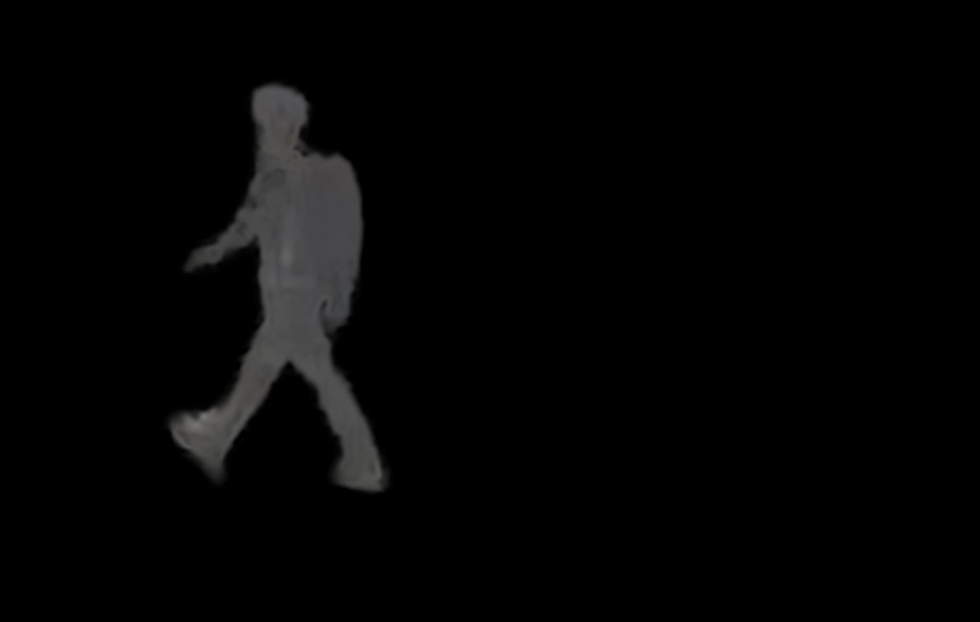
My own walking posture in Abbey Road Movies

